When people think of cryptocurrency, they usually think of Bitcoin—digital gold for individuals—or Ethereum—a platform for decentralized applications. But there’s another major player in the crypto space with a very different focus: Ripple and its digital asset XRP.
Unlike most cryptocurrencies that aim to disrupt traditional finance, Ripple aims to work with it. The company’s goal is to modernize the global payments system, making cross-border transactions faster, cheaper, and more reliable for banks and financial institutions. This guide explains what Ripple is, how XRP fits into the picture, and why the project has been at the center of a major legal battle.
The Problem: Cross-Border Payments Are Broken
If you’ve ever sent money internationally, you know the pain. You go to your bank, pay a hefty fee, and wait 3-5 business days for the money to arrive. The recipient might get less than you sent due to poor exchange rates and intermediary bank fees. For businesses moving millions of dollars, this inefficiency costs time and money.
The current system, called SWIFT, was created in the 1970s. It’s a messaging network that tells banks to move money, but it doesn’t actually move the value. Instead, banks maintain correspondent accounts with each other—pre-funded accounts in different currencies around the world. This ties up billions of dollars in capital that could be used elsewhere.
Ripple was created to solve these problems.

What is Ripple?
First, a crucial distinction: Ripple is the name of the company (Ripple Labs Inc.), while XRP is the name of the digital asset that runs on the XRP Ledger. People often use «Ripple» to refer to both, but technically they’re separate.
Ripple Labs created the XRP Ledger and holds a large portion of XRP tokens. The company’s mission is to enable «Internet of Value»—a world where money moves as easily as information does today. They’ve built several products aimed at financial institutions:
1. RippleNet
RippleNet is a network of banks and financial institutions that use Ripple’s technology to communicate and process payments. It’s similar to SWIFT but faster and more modern. Members include Santander, American Express, and hundreds of other financial institutions around the world.
2. On-Demand Liquidity (ODL)
This is where XRP comes in. ODL uses XRP as a bridge currency to facilitate cross-border payments. Instead of pre-funding accounts in different currencies, a bank can send XRP, which is then instantly converted to the local currency on the other end. This frees up capital and enables real-time settlements.
3. xCurrent
xCurrent is Ripple’s messaging and settlement software for banks. It allows two financial institutions to communicate, verify payment details, and settle transactions in real-time. xCurrent does not require XRP—it works with fiat currency.
The XRP Ledger: A Different Kind of Blockchain
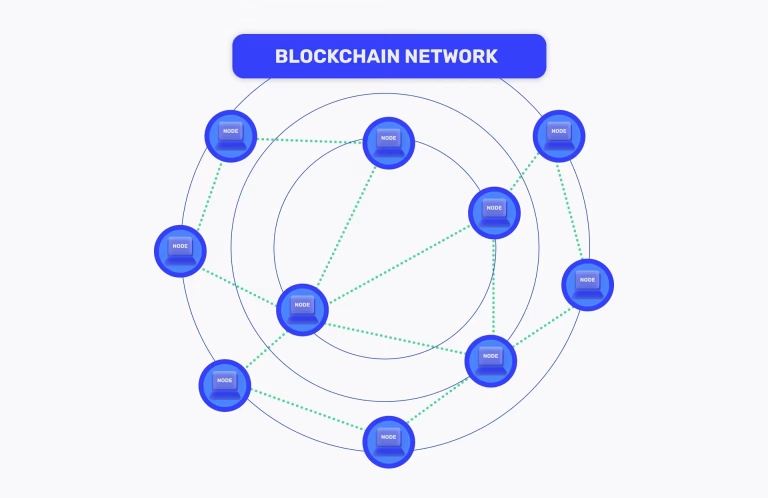
The XRP Ledger (XRPL) is the decentralized blockchain that XRP runs on. But it’s quite different from Bitcoin or Ethereum:
1. Consensus Mechanism: XRP Ledger Consensus Protocol
Unlike Bitcoin’s Proof-of-Work or Ethereum’s Proof-of-Stake, the XRPL uses a unique federated consensus mechanism. A set of trusted validators (called Unique Node Lists or UNLs) agree on which transactions are valid. This allows for:
- Speed: Transactions settle in 3-5 seconds (compared to minutes or hours for Bitcoin).
- Low Cost: The fee per transaction is fractions of a penny (0.00001 XRP).
- Energy Efficiency: The XRPL uses negligible energy compared to Proof-of-Work blockchains.
Critics argue that this mechanism is more centralized than PoW or PoS because it relies on a default list of validators. However, anyone can run a validator, and users can choose which validators to trust.
2. Native Features
The XRPL has several built-in features that other blockchains require smart contracts for:
- Decentralized Exchange (DEX): The XRPL has a built-in DEX for trading XRP and issued currencies.
- Tokens: Anyone can issue their own tokens on the XRPL (similar to Ethereum’s ERC-20).
- Payment Channels: Enable fast, off-chain payments that settle on-chain later.
- Escrow: Lock XRP for a specified time or until certain conditions are met.
What is XRP?
XRP is the native cryptocurrency of the XRP Ledger. It serves several purposes:
1. Bridge Currency
This is XRP’s primary use case in Ripple’s vision. When two currencies don’t have a direct trading pair (e.g., Mexican Pesos and Philippine Pesos), XRP can serve as a bridge. A bank can send XRP, which is then instantly converted to the destination currency. This eliminates the need for pre-funded accounts in every currency pair.
2. Transaction Fees
Every transaction on the XRP Ledger requires a small fee in XRP. This fee is burned (destroyed), which creates deflationary pressure. The fee is tiny—typically less than a penny—and is designed to prevent spam attacks.
3. Reserve Requirement
To prevent ledger bloat, accounts on the XRPL must hold a minimum reserve of XRP (currently 10 XRP for a basic account, plus more for additional features). This reserve is not burned—it’s just locked and can be recovered if the account is closed.
XRP Tokenomics
XRP has some unique economic characteristics:
- Maximum Supply: 100 billion XRP were created at inception—no more will ever be created. This is different from Bitcoin, which is mined over time, and Ethereum, which has no fixed supply.
- Distribution: Ripple Labs received 80 billion XRP initially, with 20 billion given to the founders. Ripple has been releasing XRP from escrow over time to fund operations and incentivize adoption.
- Escrow: To provide predictability, Ripple placed 55 billion XRP into a series of escrows that release 1 billion per month. Unused XRP is returned to escrow, creating a predictable supply schedule.
- Deflationary Mechanism: Transaction fees are burned, permanently removing XRP from circulation. Over time, this could make XRP deflationary if enough transactions occur.
Ripple vs. Other Cryptocurrencies
| Feature | Ripple (XRP) | Bitcoin (BTC) | Ethereum (ETH) |
|---|---|---|---|
| Primary Purpose | Cross-border payments for banks | Digital gold, peer-to-peer cash | Smart contracts, dApps, DeFi |
| Consensus | Federated Consensus (XRP Ledger) | Proof-of-Work | Proof-of-Stake |
| Transaction Speed | ~1,500 TPS (3-5 seconds finality) | ~7 TPS (10-60 minutes) | ~15-30 TPS L1 (12 seconds) |
| Transaction Fee | ~$0.0002 (fractions of a penny) | Variable ($1-$10 average) | Variable ($1-$50 depending on congestion) |
| Energy Consumption | Negligible | Very high (country-level) | Low (since PoS Merge) |
| Target Audience | Banks, financial institutions | Individuals, investors | Developers, users, enterprises |
| Governance | Ripple Labs influences development | Decentralized community | Ethereum Foundation + community |
The SEC Lawsuit: A Defining Moment for Ripple
No discussion of Ripple is complete without addressing the elephant in the room: the lawsuit with the U.S. Securities and Exchange Commission (SEC).
What Happened?
In December 2020, the SEC filed a lawsuit against Ripple Labs and its executives, alleging that XRP is an unregistered security. The SEC claims that Ripple’s sales of XRP violated securities laws, similar to how a company can’t sell shares of stock without registering with the SEC.
Ripple argued that XRP is a currency or a commodity, not a security, and that the SEC had failed to provide fair notice. The case has been closely watched by the entire crypto industry because its outcome could set a precedent for how other cryptocurrencies are regulated in the US.
Key Rulings (as of 2023-2024)
In July 2023, a federal judge delivered a landmark ruling:
- Programmatic Sales: XRP sold to the public on exchanges is not a security. This was a major victory for Ripple and for retail investors.
- Institutional Sales: XRP sold directly to institutional investors is a security. This was a partial loss for Ripple.
The ruling created a distinction between how XRP is sold—to whom and under what circumstances—rather than declaring XRP itself a security or not. This nuanced outcome has been seen as a positive development for the crypto industry, though the case continues with further proceedings.
Impact on XRP
Following the 2023 ruling, XRP’s price surged, and many US exchanges that had delisted XRP (like Coinbase) relisted it. The case remains a defining factor for Ripple’s future and for crypto regulation in the US.
Ripple’s Adoption and Partnerships
Despite the legal battle, Ripple has continued to build partnerships around the world:
- Over 300 financial institutions in more than 40 countries use Ripple’s technology.
- On-Demand Liquidity (ODL) corridors exist between the US, Mexico, Philippines, Japan, Europe, Australia, and more.
- Central Banks: Ripple is working with several central banks on CBDC (Central Bank Digital Currency) projects, using the XRP Ledger as a platform.
- Partners include: Santander, American Express, SBI Holdings, Bank of America (as a user of RippleNet), and many others.
It’s worth noting that many of these partnerships use RippleNet (which doesn’t require XRP) rather than ODL (which does). The extent to which XRP itself is being used for payments remains a topic of debate.
Criticisms and Controversies
1. Centralization
Critics argue that Ripple is too centralized. Ripple Labs holds a massive amount of XRP, and the company has significant influence over the network’s development. The validator set, while open, is largely controlled by entities approved by Ripple. For purists who believe in complete decentralization, this is a major flaw.
2. Is XRP Really Needed?
Some question whether XRP is necessary for Ripple’s payments vision. RippleNet works perfectly well without XRP, and most of Ripple’s bank partners use xCurrent, which doesn’t require XRP. The ODL use case, while growing, remains a small part of Ripple’s business.
3. Dump Concerns
Because Ripple holds such a large amount of XRP and releases it from escrow monthly, there’s concern that selling pressure could depress the price. Ripple insists it uses XRP strategically to support the ecosystem, but critics remain skeptical.
4. Competition
Ripple faces competition from other blockchain projects targeting cross-border payments (Stellar, which was founded by a Ripple co-founder, is a direct competitor) as well as from traditional systems like SWIFT’s own upgrades and new fintech solutions.
The Future of Ripple and XRP
Looking ahead, several factors will shape Ripple’s trajectory:
- SEC Lawsuit Resolution: A final resolution (which could take years) will provide clarity and potentially open the door for more US adoption.
- IPO: Ripple has discussed going public once the lawsuit is resolved, which could bring more legitimacy and capital.
- CBDC Development: Ripple is well-positioned to help central banks issue digital currencies, which could be a massive market.
- ODL Expansion: If Ripple can convince more banks to use XRP for liquidity, demand could increase significantly.
- XRPL Upgrades: The XRP Ledger continues to evolve, with new features like native smart contracts (via Hooks) and sidechains being explored.
Conclusion
Ripple and XRP occupy a unique space in the cryptocurrency ecosystem. While Bitcoin and Ethereum aim to displace traditional finance, Ripple aims to upgrade it. By focusing on the real-world problem of cross-border payments, Ripple has built partnerships with hundreds of financial institutions and created one of the fastest, cheapest, and most energy-efficient blockchains in existence.
However, the project’s centralization, the ongoing SEC lawsuit, and questions about XRP’s necessity mean it remains controversial. For investors and users, understanding both the technology and the regulatory landscape is essential.
Whether Ripple succeeds in its vision of an «Internet of Value» or is overtaken by competitors or regulatory hurdles, it has already left an indelible mark on the crypto industry.
Disclaimer: This article is for informational purposes only and does not constitute financial advice. Cryptocurrency investments carry risk. Always do your own research.