As cryptocurrency has grown from a niche internet experiment to a multi-trillion-dollar asset class, governments around the world have grappled with how to regulate it. The approaches vary wildly—from embracing innovation with open arms to outright bans.
Understanding the regulatory landscape is essential for anyone involved in crypto. It affects where you can trade, how you’re taxed, and what the future might hold. This guide provides an overview of crypto regulation across major jurisdictions and the key trends shaping the future.
The Regulatory Spectrum
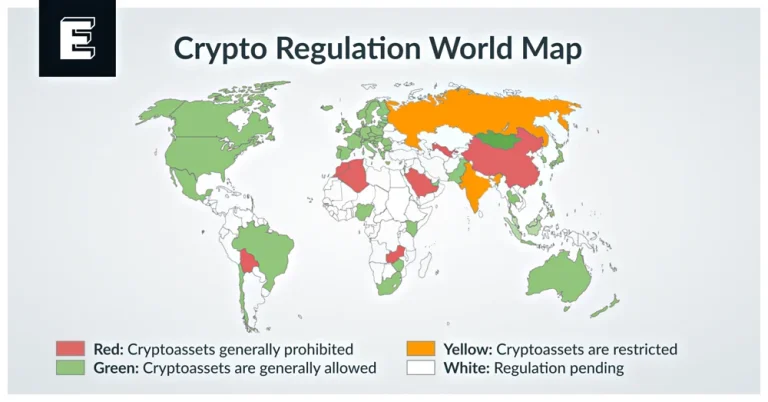
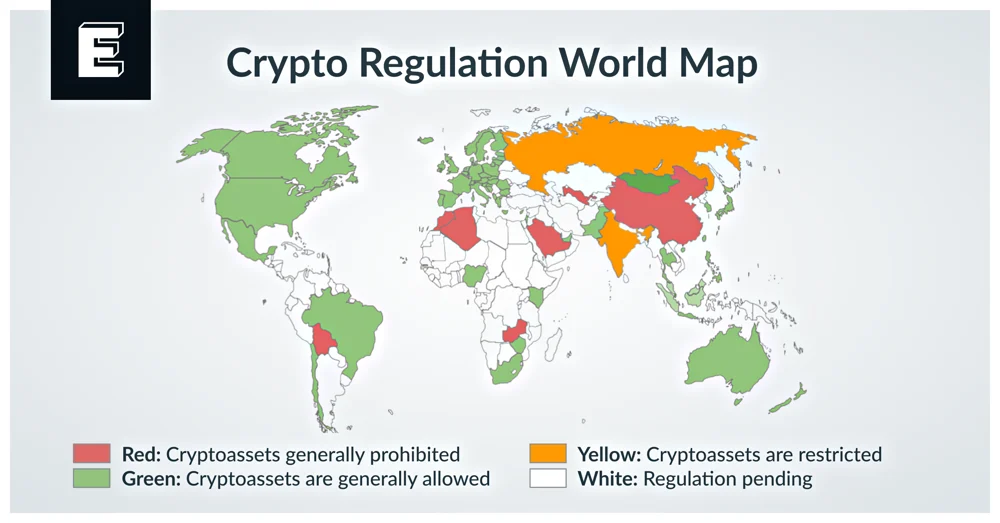
Countries generally fall into one of three categories in their approach to crypto:
- Crypto-Friendly: Clear, supportive regulations that encourage innovation and adoption. Examples: Switzerland, Singapore, UAE.
- Cautiously Optimistic: Developing regulatory frameworks, allowing crypto to exist but with oversight. Examples: EU, UK, Japan.
- Restrictive or Hostile: Heavy restrictions, de facto bans, or outright prohibitions. Examples: China, Bolivia, Egypt.
But even within these categories, the details matter—tax treatment, licensing requirements, and which activities are permitted vary enormously.

United States: A Complex Patchwork
The US has one of the most complex and fragmented regulatory environments for crypto. Multiple agencies claim jurisdiction, often with overlapping and sometimes conflicting rules.
Key Regulators
- SEC (Securities and Exchange Commission): Chair Gary Gensler has taken the position that most cryptocurrencies (except Bitcoin) are securities and should be regulated as such. The SEC has brought enforcement actions against major exchanges (Binance, Coinbase) and projects (Ripple, though with mixed results).
- CFTC (Commodity Futures Trading Commission): Treats Bitcoin and Ethereum as commodities. Regulates futures and derivatives trading.
- FinCEN (Financial Crimes Enforcement Network): Requires crypto exchanges to register as Money Services Businesses and follow AML/KYC rules.
- IRS (Internal Revenue Service): Treats crypto as property for tax purposes. Every transaction is a taxable event.
- State Regulators: New York’s BitLicense is a famous (and controversial) state-level licensing regime.
Key Developments
- Spot Bitcoin ETFs: Approved in January 2024, a major milestone for mainstream adoption.
- SEC Lawsuits: Ongoing cases against Binance, Coinbase, and others could shape the future of crypto in the US.
- Stablecoin Legislation: Congress is considering bills to regulate stablecoins, which could provide clarity.
- Tax Reporting: New rules require brokers (including some DeFi platforms) to report transactions to the IRS.
Outlook: The US remains a challenging environment for crypto businesses, with regulatory uncertainty and enforcement-heavy approach. Clearer legislation is possible but politically difficult.
European Union: MiCA Leads the Way
The EU has taken a comprehensive, unified approach with the Markets in Crypto-Assets (MiCA) regulation, passed in 2023.
MiCA Overview
MiCA creates a harmonized regulatory framework across all 27 EU member states. Key provisions:
- Crypto-asset service providers (exchanges, wallets) must obtain a license and meet capital requirements.
- Stablecoin issuers must maintain adequate reserves and be supervised.
- Consumer protection rules, including transparency requirements and liability for losses.
- Environmental disclosures for Proof-of-Work cryptocurrencies (though no ban on PoW).
MiCA doesn’t fully cover DeFi or NFTs (though NFTs may be regulated if they function like financial instruments). It’s seen as a model for other jurisdictions seeking regulatory clarity.
Individual Country Approaches
Before MiCA, countries had different approaches:
- Germany: Early adopter, allows banks to custody crypto, requires licenses.
- France: Created a optional licensing regime (PSAN) to attract crypto businesses.
- Others: Varying degrees of openness, but MiCA will unify them.
Outlook: The EU is becoming one of the most clear and crypto-friendly major jurisdictions, with MiCA providing regulatory certainty.
United Kingdom: Post-Brexit Ambitions
The UK left the EU before MiCA was finalized and is developing its own approach. The government has expressed ambitions to make the UK a “global hub for cryptoasset technology.”
Current Framework
- FCA (Financial Conduct Authority): Regulates crypto exchanges and requires registration with strict AML checks. Many firms have struggled to meet FCA standards.
- Stablecoins: Legislation is progressing to bring stablecoins into the regulatory perimeter.
- Future Plans: The government has consulted on broader crypto regulation, including DeFi, and aims to create a tailored regime.
Outlook: The UK wants to be crypto-friendly but maintains high standards. It’s too early to tell if it will succeed in becoming a hub.
Asia: A Tale of Contrasts
China: The Hardline Approach
China has taken the most hostile stance of any major economy:
- 2017: Banned ICOs and crypto exchanges.
- 2021: Declared all crypto transactions illegal, banned mining, and cracked down on exchanges.
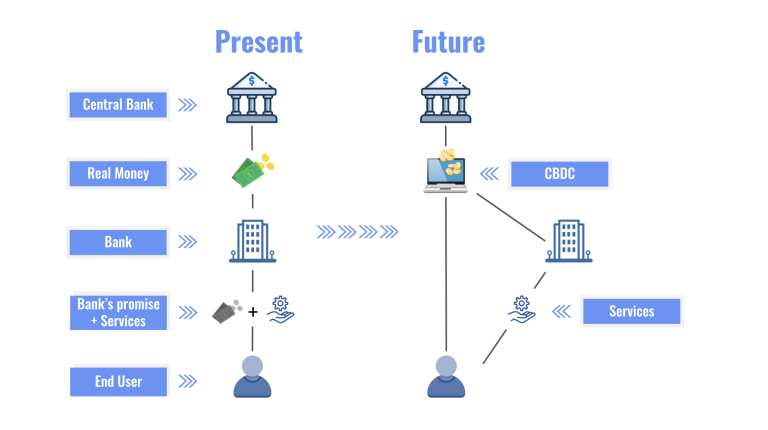
- However, China is aggressively developing its own digital yuan (CBDC) and has not banned blockchain technology itself.
Outlook: Unlikely to change in the near term. Crypto remains banned.
Singapore: The Crypto Hub
Singapore has positioned itself as a leading crypto hub with clear, business-friendly regulation:
- Payment Services Act: Requires licensing for crypto service providers. Many major exchanges (Bybit, OKX) have applied for licenses or operate from Singapore.
- MAS (Monetary Authority of Singapore): Takes a balanced approach—supporting innovation while focusing on consumer protection and AML.
- Restrictions: Strict limits on crypto advertising to the public, and some retail trading restrictions.
Outlook: Singapore will likely remain a leading global crypto hub, though with ongoing regulatory refinement.
Japan: Early Adopter, Strict Rules
Japan was one of the first countries to regulate crypto after the Mt. Gox collapse:
- Recognized Bitcoin as legal property (not currency) in 2017.
- Requires exchange registration with the FSA (Financial Services Agency).
- Strict rules on custody, segregation of funds, and consumer protection.
- Approved crypto ETFs? Not yet, but considering.
Outlook: Stable, regulated, but with high compliance costs.
South Korea: Active Market, Strict Rules
South Korea has a massive retail crypto market but also strict regulations:
- Real-name bank accounts required for trading.
- Exchanges must register with financial authorities.
- Strict rules on token listings and disclosures.
- Taxation of crypto gains (planned, with delays).
Outlook: Active and regulated, with political support but also caution.
Hong Kong: New Hub Ambitions
Hong Kong has recently moved to re-establish itself as a crypto hub, despite (or perhaps because of) China’s ban:
- Licensing regime for exchanges launched in 2023.
- Retail trading permitted on licensed exchanges.
- Stablecoin regulation under development.
Outlook: Aiming to attract crypto businesses, but geopolitical tensions and China’s stance create uncertainty.
India: The Pendulum
India’s approach has swung back and forth:
- 2018: RBI banned banks from crypto (overturned by Supreme Court in 2020).
- 2022: Heavy taxes (30% on gains, 1% TDS on transactions) effectively discouraged trading.
- Current: Regulatory uncertainty continues, with no clear legal framework. Some exchanges have left, others stay.
Outlook: Unclear. India wants to be a leader in digital public infrastructure but remains wary of private crypto.
Middle East: Emerging Hubs
UAE (Dubai/Abu Dhabi)
The UAE has aggressively pursued crypto leadership:
- Dubai: Created the Virtual Assets Regulatory Authority (VARA) and free zones for crypto businesses.
- Abu Dhabi: Global Market (ADGM) has a comprehensive crypto framework.
- Many major exchanges (Binance, Bybit, etc.) have established regional headquarters in the UAE.
Outlook: One of the most favorable jurisdictions globally for crypto businesses.
Other Middle East
- Bahrain: Early adopter with clear regulations.
- Saudi Arabia: Cautious, with restrictions but some central bank experiments.
- Israel: Developing regulatory framework, treats crypto as asset for tax.
- Turkey: Huge retail adoption, but regulatory framework is developing (new law in 2024).
Other Notable Jurisdictions
Switzerland (and Liechtenstein)
Switzerland’s “Crypto Valley” in Zug has been a global hub for years:
- Clear, favorable regulation.
- Ethereum Foundation based in Zug.
- Many ICOs and crypto companies operate from Switzerland.
Australia
- Crypto is legal and treated as property for tax.
- Exchanges must register with AUSTRAC for AML.
- Consulting on broader regulation, including licensing and custody rules.
Canada
- Crypto exchanges must register with provincial securities regulators.
- Approved Bitcoin ETFs before the US.
- Stricter rules on leverage and stablecoins after some exchange failures.
Brazil
- Passed comprehensive crypto law in 2022.
- Central bank will regulate, with licensing expected.
- High adoption, especially for stablecoins.
Nigeria
- One of the highest adoption rates globally.
- Central bank banned banks from crypto in 2021 (later reversed).
- e-Naira CBDC launched but adoption low.
- Regulatory uncertainty continues.
El Salvador
- First country to adopt Bitcoin as legal tender (2021).
- Controversial, with IMF criticism and mixed results.
- Bitcoin bonds, “Bitcoin City” planned but delayed.
Key Regulatory Themes
Across all jurisdictions, several common themes emerge:
1. AML/KYC
Almost all regulated jurisdictions require crypto businesses to implement Anti-Money Laundering and Know Your Customer procedures. The FATF (Financial Action Task Force) sets global standards that most countries follow.
2. Consumer Protection
Rules around custody of customer funds, disclosures, and handling of complaints are becoming standard.
3. Stablecoin Regulation
Following the Terra collapse, stablecoins are a focus. MiCA and other frameworks require issuers to hold reserves and be supervised.
4. Taxation
Most countries tax crypto, but the treatment varies: property (capital gains), income, or even VAT in some cases.
5. Securities vs. Commodities
The classification of crypto assets determines which regulator has authority. This is a major unresolved issue, especially in the US.
6. DeFi and NFTs
Most current regulations focus on centralized intermediaries. DeFi and NFTs remain largely unregulated, but that’s changing.
What This Means for Users
For individuals, the regulatory landscape affects:
- Where you can trade: Some exchanges restrict users from certain countries.
- Tax obligations: You need to understand your local tax rules.
- Privacy: KYC requirements mean your identity is linked to your transactions.
- Risk: Regulatory changes can impact prices and access.
Always check your local laws and use compliant exchanges where required.
The Future of Crypto Regulation
Several trends will shape the next phase:
- International Coordination: G20, FATF, and other bodies are pushing for consistent global standards.
- CBDC Development: As central banks issue digital currencies, they may compete with or coexist with crypto.
- DeFi Regulation: Expect attempts to regulate decentralized finance, though how remains unclear.
- Stablecoin Dominance: Regulated stablecoins may become the primary on-ramp for institutional investors.
Conclusion
Crypto regulation is a complex, rapidly evolving patchwork. Some jurisdictions embrace innovation with clear rules; others remain hostile or uncertain. Understanding where you stand—and where you’re trading—is essential.
The trend is toward more regulation, not less. But done right, clear rules could provide the foundation for mainstream adoption, protecting consumers while allowing innovation to flourish.
Disclaimer: This article is for informational purposes only and does not constitute legal advice. Regulations change frequently. Always consult a qualified professional for advice specific to your situation.