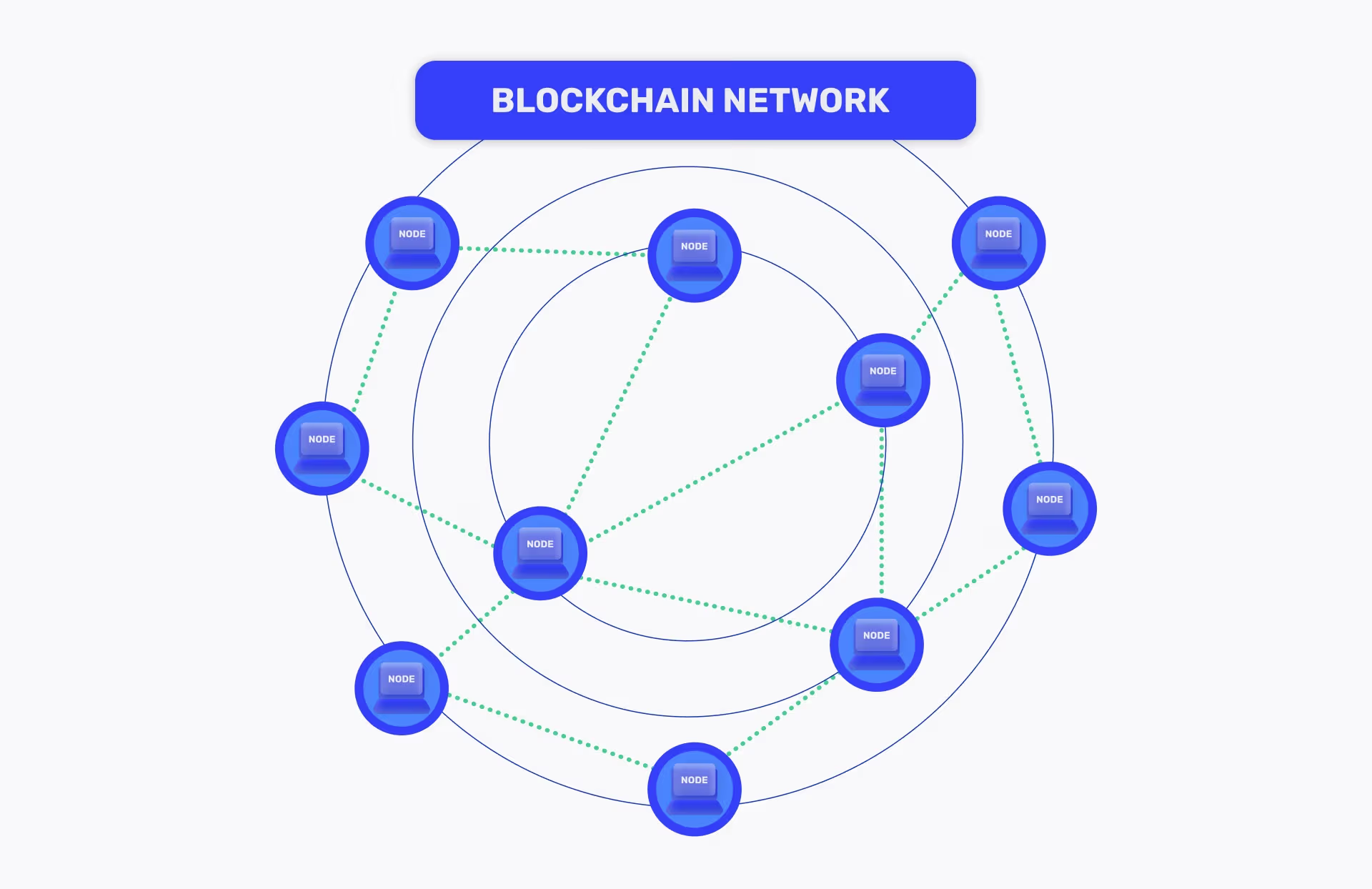
When people talk about blockchain, they often focus on the exciting parts—cryptocurrencies, DeFi, NFTs. But underneath all of that is a global network of computers doing the quiet, essential work of keeping the system running. These computers are called nodes.
Without nodes, there is no blockchain. They store the data, validate transactions, and maintain consensus. They are the backbone of every decentralized network. This guide explains what nodes are, how they work, the different types, and why running one matters.
What is a Node?
A node is any computer that connects to a blockchain network and participates in it. Nodes communicate with each other, share information, and collectively maintain the distributed ledger.
Think of a blockchain like a massive, shared Google Doc that everyone can see but no one can delete. Each node is like a computer that has a copy of that document and helps keep it updated. If one computer goes offline, thousands of others still have the document, so nothing is lost.
Nodes perform several critical functions:
- Store the blockchain: They keep a copy of the entire transaction history (or a portion of it).
- Validate transactions: They check that new transactions follow the network’s rules.
- Relay information: They pass transactions and blocks to other nodes.
- Maintain consensus: They agree on the current state of the blockchain.

Why Are Nodes Important?
Nodes are what make blockchain decentralized. In a traditional database, there’s one central server controlled by one company. If that server goes down or is hacked, the system fails.
In a blockchain, there are thousands (or tens of thousands) of independent nodes around the world. This provides:
- Redundancy: If some nodes go offline, the network continues.
- Censorship resistance: No single entity can block transactions or change the rules.
- Security: To attack the network, you’d need to control a majority of nodes, which is practically impossible on large networks.
- Transparency: Anyone can run a node and verify the entire history for themselves.
The more nodes a network has, the more decentralized and resilient it becomes.
Types of Nodes
Not all nodes are the same. They can be categorized by how much data they store and what functions they perform.
1. Full Nodes
A full node downloads and stores the entire blockchain. It independently verifies every transaction and block against the network’s consensus rules. This is the most important type of node for decentralization.
What full nodes do:
- Maintain a complete copy of the blockchain.
- Validate all transactions and blocks.
- Relay transactions and blocks to other nodes.
- Enforce the network’s rules (like rejecting invalid blocks).
Running a full node means you don’t have to trust anyone else. You can verify for yourself that the blockchain is following the rules. This is the essence of “don’t trust, verify.”
Examples: Bitcoin Core full node, Geth or Nethermind (Ethereum full node).
Requirements: Running a full node requires significant storage (Bitcoin’s blockchain is ~500 GB, Ethereum’s is ~1 TB+), bandwidth, and time to sync initially.
2. Light Nodes (or Light Clients)
A light node does not download the entire blockchain. Instead, it downloads only block headers and relies on full nodes for transaction data. It uses a technique called simplified payment verification (SPV) to verify that transactions are included in blocks.
Light nodes are much less resource-intensive. They can run on mobile phones or low-power devices. Most mobile wallets (like Trust Wallet or MetaMask mobile) are light clients.
Trade-off: Light nodes are less secure than full nodes because they must trust that the full nodes they connect to are providing correct information. However, they can check that a transaction is in a block by verifying the block header.
3. Mining Nodes (Proof-of-Work)
Mining nodes (also called miners) are full nodes that also perform the additional work of creating new blocks. In Proof-of-Work systems like Bitcoin, miners compete to solve complex mathematical puzzles. The first to solve it gets to add the next block and earn the block reward.
Mining nodes require specialized hardware (ASICs) and consume significant electricity. They play a crucial role in securing the network, but they’re also full nodes—they maintain a complete copy of the blockchain and validate everything.
4. Validator Nodes (Proof-of-Stake)
In Proof-of-Stake systems like Ethereum (post-Merge), validator nodes replace miners. Validators stake their own cryptocurrency as collateral and are randomly selected to propose and attest to blocks. If they act honestly, they earn rewards. If they misbehave, their stake can be slashed (partially destroyed).
Validator nodes are also full nodes—they maintain the blockchain state and validate transactions. Running a validator typically requires a minimum stake (32 ETH on Ethereum) and technical knowledge.
5. Archive Nodes
An archive node is a full node that also stores the entire historical state of the blockchain at every block. This allows you to query the balance of any address at any point in history or debug complex smart contract interactions.
Archive nodes require enormous storage (tens of terabytes) and are usually run by blockchain explorers (like Etherscan), dApp developers, and researchers. Most users don’t need an archive node.
6. Pruned Nodes
A pruned node is a full node that downloads the entire blockchain but then deletes older data, keeping only the most recent blocks (typically a few GB). It still validates the entire chain during sync but doesn’t store all historical data afterward. This saves disk space while maintaining the security benefits of a full node.
How Many Nodes Are There?
The number of nodes varies by blockchain:
- Bitcoin: Approximately 15,000-20,000 reachable full nodes, plus many more unreachable (behind firewalls).
- Ethereum: Approximately 5,000-8,000 reachable full nodes, plus many light clients.
- Smaller blockchains: May have hundreds or a few thousand nodes.
These numbers are rough and change over time. You can check current estimates on sites like bitnodes.io (Bitcoin) or ethernodes.org (Ethereum).
It’s worth noting that the number of reachable nodes is only part of the picture. Many nodes run behind NATs or firewalls and aren’t publicly visible but still contribute to the network.
Can Anyone Run a Node?
Yes! That’s the beauty of public blockchains. Anyone with a computer and an internet connection can run a node. You don’t need permission, and you don’t need to hold any cryptocurrency (for a non-mining/validating node).
Running a node contributes to the network’s decentralization and gives you the ability to verify transactions for yourself. It’s a way to participate beyond just owning coins.
Requirements vary:
- Bitcoin full node: ~500 GB free disk space, 2+ GB RAM, broadband connection, a few days to sync initially.
- Ethereum full node: ~1+ TB SSD (fast storage required), 8+ GB RAM, fast internet, several days to sync.
- Light node: Minimal resources, can run on a Raspberry Pi or even a phone.
You can also run a pruned node to save disk space after initial sync.
Why Run Your Own Node?
You might wonder: why bother running a node when you can just use a wallet that connects to someone else’s node (like Infura or a public RPC)?
Here are the benefits:
1. Sovereignty and Trust Minimization
When you run your own node, you don’t have to trust anyone. You verify every transaction and block yourself. This is the core principle of “don’t trust, verify.” If you rely on a third-party node, you’re trusting that they’re showing you the correct blockchain state.
2. Privacy
When you connect to a public node, that node can see your IP address and which addresses you’re querying. Running your own node keeps your blockchain activity private.
3. Supporting the Network
Every node strengthens the network. More nodes mean more copies of the blockchain, making it harder to attack and more resilient to failures.
4. Reliability
Public nodes can go down or rate-limit you. Your own node is always available (as long as your internet is up).
5. Educational Value
Running a node is a great way to learn how blockchain actually works under the hood.
Nodes and Decentralization: The Critical Link
A blockchain is only as decentralized as its node distribution. If most nodes are run by one company or in one country, the network becomes vulnerable to censorship or attack.
This is why projects encourage node diversity—different software clients, different geographic locations, different hardware. For example, Ethereum promotes multiple client implementations (Geth, Nethermind, Besu, Erigon) so that a bug in one client doesn’t take down the entire network.
The ideal is a network with thousands of nodes spread across the world, run by individuals, businesses, and institutions, all enforcing the same rules independently.
How to Run a Node
Running a node is easier than ever. Here are some options:
Bitcoin
- Bitcoin Core: The reference client. Download from bitcoin.org, let it sync, and you’re running a full node.
- Umbrel: A user-friendly platform that makes running a Bitcoin (and Lightning) node easy on a Raspberry Pi or regular computer.
- MyNode: Another easy-to-use appliance for running a Bitcoin node.
Ethereum
- Geth: The most popular Ethereum client. Requires command-line knowledge.
- Nethermind: A .NET client with good documentation.
- DappNode: A platform for running Ethereum and other nodes with an easy web interface.
- Stereum: A GUI installer for Ethereum nodes.
Light Nodes
- Many wallets (like Electrum for Bitcoin or MetaMask mobile for Ethereum) run light clients by default.
Node Comparison Table
| Node Type | Stores Full Blockchain | Validates Transactions | Resource Requirements | Typical Use |
|---|---|---|---|---|
| Full Node | Yes | Yes | High (hundreds of GB – TB) | Individuals, businesses, exchanges |
| Pruned Node | Partial (recent only) | Yes (during sync) | Medium (5-10 GB after pruning) | Users with limited disk space |
| Light Node | No (headers only) | Partial | Low | Mobile wallets, low-power devices |
| Miner/Validator Node | Yes | Yes | High + specialized hardware/stake | Securing the network, earning rewards |
| Archive Node | Yes (all historical state) | Yes | Very high (tens of TB) | Blockchain explorers, researchers |
Conclusion
Nodes are the unsung heroes of blockchain. They don’t get the headlines that Bitcoin or Ethereum do, but without them, there would be no network to talk about. They store the data, enforce the rules, and maintain the decentralized consensus that makes blockchain technology revolutionary.
Understanding nodes helps you appreciate what decentralization really means. And running your own node is one of the most direct ways to participate in and support the network you care about.
Disclaimer: This article is for informational purposes only. Running a node requires technical knowledge and resources. Always research requirements before starting.