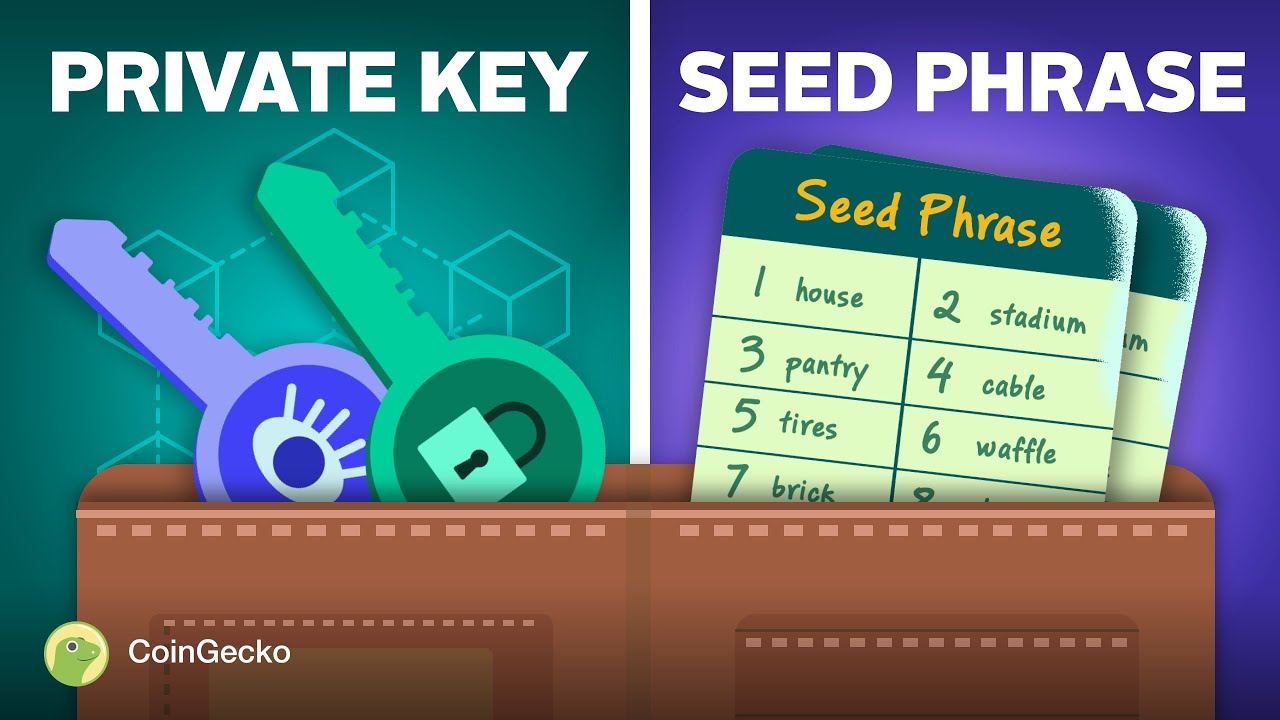
In the world of cryptocurrency, there’s one rule that overrides all others: not your keys, not your coins. This phrase captures the essence of self-custody—the idea that if you don’t control your private keys, you don’t truly own your cryptocurrency.
But what exactly are private keys? And what’s a seed phrase? Why are they so important, and how do you keep them safe? This guide answers these questions and explains why these strings of characters are the most important thing you’ll ever store.
The Analogy: A Bank Account vs. Crypto
To understand private keys, let’s compare crypto to a traditional bank account.
With a bank account:
- Your account number is like your public address. You give it to people so they can send you money.
- Your PIN and password are like your private key. You use them to access your account and authorize transactions.
- The bank is like the blockchain network. It keeps track of balances and verifies transactions.
But there’s a crucial difference: with a bank, if you forget your PIN, you can call customer service and reset it. The bank controls the account, so they can help you recover access.
With cryptocurrency, there is no customer service. If you lose your private key, you lose your funds forever. No one can help you recover them. This is the reality of self-custody—you are your own bank.

What is a Private Key?
A private key is a secret number that allows you to spend your cryptocurrency. It’s a long, randomly generated string of characters that proves you own the funds associated with a specific public address.
In technical terms, a private key is a 256-bit number, which means it can be any number from 1 to about 10^77. That’s roughly the number of atoms in the observable universe. This enormous range makes it practically impossible for anyone to guess your private key.
Private keys look like this (in hexadecimal format):
5Kb8kLf9zgWQnogidDA76MzPL6TsZZY36hWXMssSzNydYXYB9KF
Every private key has a corresponding public key and public address. The public address is derived from the private key through cryptographic hashing—a one-way function that’s easy to compute but impossible to reverse. You can generate a public address from a private key, but you cannot derive the private key from the public address.
What is a Seed Phrase?
If you’ve ever set up a cryptocurrency wallet like MetaMask, Trust Wallet, or a Ledger hardware wallet, you were given a set of 12 or 24 random words. That’s your seed phrase (also called a recovery phrase, mnemonic phrase, or backup phrase).
A seed phrase looks like this:
sunny orange dog bridge galaxy happy turtle fire rocket forest pencil eagle
The seed phrase is actually a human-readable encoding of your master private key. Instead of having to write down a long, complex string of characters, you write down 12 or 24 simple words. These words come from a standardized list of 2048 words (BIP39 standard).
The seed phrase is the master key to your entire wallet. From this single seed phrase, a wallet can generate an unlimited number of private keys and public addresses (one for each cryptocurrency you hold). This is called a hierarchical deterministic (HD) wallet.
This means:
- If you have your seed phrase, you can recover your entire wallet—all your accounts, all your cryptocurrencies—on any compatible wallet software.
- If someone gets your seed phrase, they can steal everything.
- If you lose your seed phrase, you lose access to everything. No recovery is possible.
How Private Keys and Seed Phrases Work Together
Here’s the relationship:
- Your seed phrase is created when you first set up your wallet. It’s typically 12 or 24 random words.
- From this seed phrase, your wallet mathematically generates a master private key.
- From the master private key, the wallet generates many child private keys—one for each cryptocurrency address you use.
- From each private key, the wallet derives a public address that you can share to receive funds.
When you want to send cryptocurrency, your wallet uses the appropriate private key to sign the transaction, proving you own the funds. The signed transaction is broadcast to the network, and miners/validators verify the signature using your public key.
Throughout this process, your private keys and seed phrase never leave your device (if you’re using a proper self-custodial wallet). They’re stored locally, and transactions are signed locally.
Why Seed Phrases Are Superior to Private Keys
You might wonder: why use seed phrases at all? Why not just write down the private key?
Seed phrases offer several advantages:
- Human-readable: 12 words are much easier to write down correctly than a long string of random characters.
- Error detection: The word list is designed so that words are distinct and easy to distinguish. If you write “cat” instead of “bat,” your wallet will usually detect the error.
- Single backup for multiple accounts: One seed phrase backs up your entire wallet—Bitcoin, Ethereum, all your altcoins, all your addresses.
- Standardization: The BIP39 standard means your seed phrase works across many different wallets. You can recover a MetaMask wallet in Trust Wallet or a Ledger wallet in a software wallet (if you ever needed to).
The Most Important Rule: Protect Your Seed Phrase
Your seed phrase is the single most sensitive piece of information in your crypto life. Follow these rules religiously:
DO:
- Write it down on paper. Use a pen and paper. Store it in a safe place—a fireproof safe, a safety deposit box, or a secure location in your home.
- Consider metal backups. Paper can burn, get wet, or deteriorate. Metal backup solutions (like Cryptosteel or Billfodl) stamp your seed phrase onto metal for protection against fire and flood.
- Make multiple copies. Store them in separate secure locations. If your house burns down, you have another copy elsewhere.
- Verify your backup. After writing it down, wipe your wallet and restore it from the seed phrase to ensure you wrote it correctly.
DON’T:
- Never store it digitally. No photos, no screenshots, no text files, no cloud storage (Google Drive, iCloud, Dropbox), no password managers (though some argue about encrypted password managers—generally avoid).
- Never share it. No legitimate service—no exchange, no support person, no “helpful” stranger—will ever ask for your seed phrase. Anyone who does is a scammer.
- Never enter it into any website. Even if a site looks legitimate, never enter your seed phrase. Wallets should only ask for your seed phrase during initial setup or recovery, and that should happen within the wallet app itself, not on a website.
- Don’t store it unencrypted on your computer. Malware can steal files. If you must store it digitally (not recommended), use strong encryption and offline storage.
What About Hardware Wallets?
A hardware wallet (like Ledger or Trezor) is a special device designed to keep your private keys offline. It generates and stores your seed phrase on the device itself, never exposing it to your internet-connected computer.
When you want to make a transaction:
- You create the transaction on your computer or phone.
- You send it to the hardware wallet for signing.
- The hardware wallet signs it using your private key (which never leaves the device).
- The signed transaction is sent back to your computer and broadcast to the network.
Even if your computer is infected with malware, your private keys remain safe because they never touch the computer. Hardware wallets are considered the gold standard for securing significant amounts of cryptocurrency.
Common Mistakes and How to Avoid Them
Mistake 1: Losing Your Seed Phrase
The problem: You forget where you put it, it gets thrown away, or it’s destroyed in a fire.
Solution: Store multiple copies in different secure locations. Use metal backups for critical amounts.
Mistake 2: Seed Phrase Theft
The problem: Someone finds your written seed phrase, or you accidentally enter it into a phishing site.
Solution: Never store it where others can find it. Never enter it online. Use a hardware wallet to keep it offline.
Mistake 3: Inheritance/Next of Kin
The problem: If something happens to you, your family may not know about or be able to access your crypto.
Solution: Plan for this. Leave instructions in your will or with a trusted person. Consider using a multisig setup where multiple people are needed to access funds.
Mistake 4: Using a Non-Standard Wallet
The problem: Some wallets use non-standard derivation paths or encryption. If that wallet stops being supported, you might not be able to recover your funds with another wallet, even with the seed phrase.
Solution: Stick to well-known, open-source wallets that follow standards (BIP39, BIP44).
Mistake 5: Taking a Photo of Your Seed Phrase
The problem: Your photo might be backed up to the cloud. If your cloud account is hacked, your crypto is gone.
Solution: Never photograph your seed phrase. Ever.
What If You Lose Your Private Key But Have the Seed Phrase?
No problem. Your seed phrase can regenerate all your private keys. That’s why backing up the seed phrase is sufficient—you don’t need to back up individual private keys.
What If You Lose Your Seed Phrase But Still Have Access to Your Wallet?
If you still have access to your wallet (on your phone or computer), you may be able to view your seed phrase in the wallet settings. Most wallets have an option to “reveal seed phrase” or “backup seed phrase.” Do this immediately and write it down. Then consider moving your funds to a new wallet with a new seed phrase, because if your current device is compromised, your seed phrase may already be exposed.
The “Not Your Keys, Not Your Coins” Philosophy
This phrase originated from the Mt. Gox exchange collapse, where users lost funds because the exchange controlled the private keys. It applies to any situation where someone else holds your keys:
- Exchanges: When you leave crypto on Coinbase, Bybit, or Binance, the exchange holds the private keys. You have an IOU, not the actual crypto. If the exchange is hacked, goes bankrupt, or freezes withdrawals, you could lose everything.
- Custodial wallets: Some “wallets” are actually custodial—they hold your keys for you. Read the fine print.
The only way to truly own your cryptocurrency is to hold it in a wallet where you control the private keys. That means self-custodial software wallets (like MetaMask) or hardware wallets.
Conclusion
Your private keys and seed phrase are the keys to your crypto kingdom. They prove ownership, authorize transactions, and are the only way to recover your funds if you lose access. With great power comes great responsibility: lose them, and your funds are gone forever. Let someone else find them, and they’re stolen.
The principles are simple: write down your seed phrase on paper, store it securely offline, never share it with anyone, and never enter it into any website. For significant amounts, invest in a hardware wallet and a metal backup.
Remember: in the world of cryptocurrency, you are your own bank. And every bank needs a secure vault.
Disclaimer: This article is for informational purposes only and does not constitute financial or security advice. Always prioritize the security of your private keys and seed phrases.